

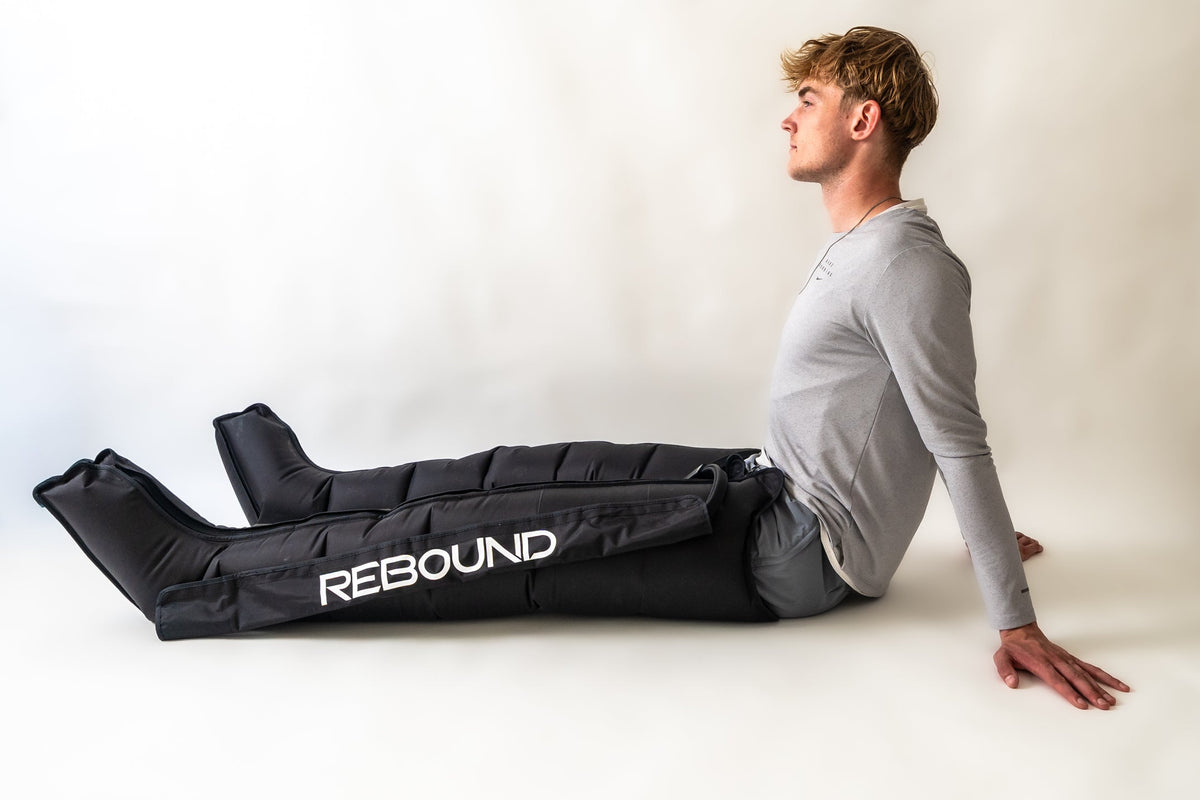
You see them more and more in changing rooms and on athletes’ social media. But what do compression boots actually do? We have put together what the research shows, without making it sound better than it is.
What was studied?
In 2024 the journal Biology of Sport published a review by Maia and colleagues. They combined 17 randomised studies with 319 participants in total, all on air compression of the legs after sport.
Where it helps
The clearest effect was on muscle soreness. Straight after the session and four days later, athletes who used air compression reported less soreness than the comparison groups. They also felt slightly more recovered and less fatigued, although that was based on only a few studies.
Where it is not (yet) proven
The researchers found no clear effect on muscle strength and performance. For blood markers such as creatine kinase (a measure of muscle damage), inflammation markers and lactate clearance, the results were mixed or absent. The authors describe the evidence as still young: many studies were small, and only a few compared against a placebo.
What does that mean for you?
Compression boots are not a miracle cure. They will not make you faster, and they do not replace sleep, good nutrition or a rest day. What they can do is make your legs feel less stiff and sore sooner after a hard session, which makes it easier to start the next one well. For many athletes, that is exactly why they own a set.
How was it used in the studies?
Sessions lasted 15 to 60 minutes, at pressures between roughly 60 and 235 mmHg. The most common protocol was 20 to 30 minutes at around 80 mmHg. To see how to apply that at home, read how often and how long to use compression boots and which pressure to choose.
Source: Maia F, Nakamura FY, Sarmento H, Marcelino R, Ribeiro J. Effects of lower-limb intermittent pneumatic compression on sports recovery: a systematic review and meta-analysis. Biology of Sport, 2024; 41(4): 263–275. Read the study.

Leave a comment
This site is protected by hCaptcha and the hCaptcha Privacy Policy and Terms of Service apply.